Intelligence
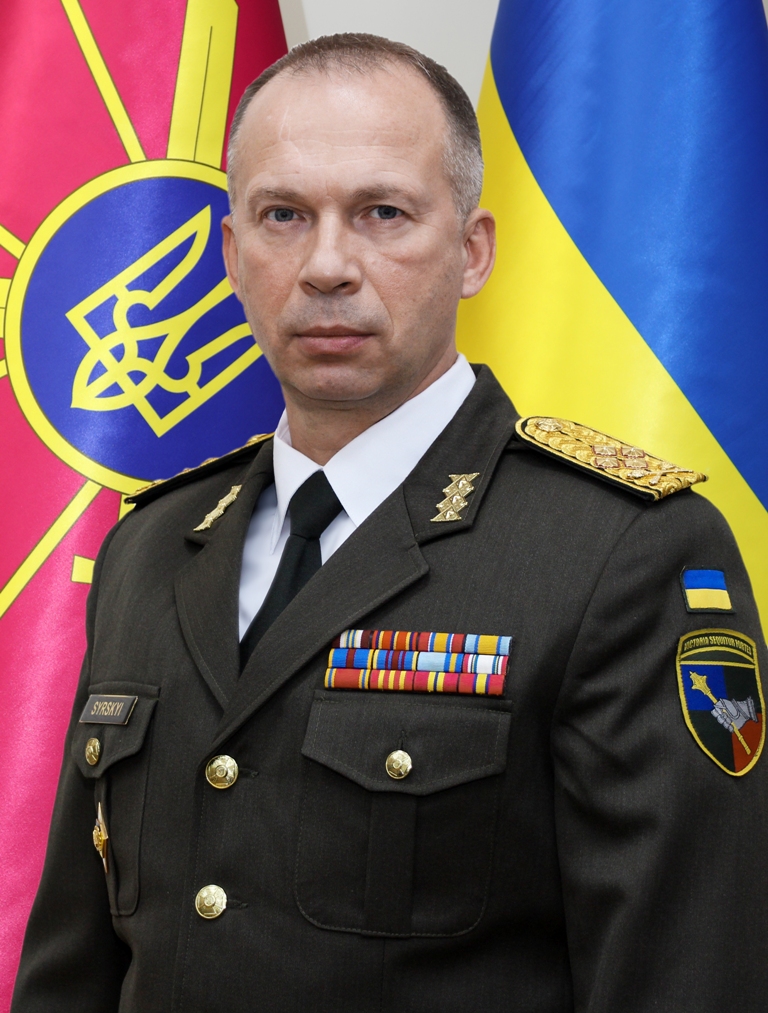
Ołeksandr Syrski
General
Identity
 Ukraine
Post
Service
Oleksandr Syrskyi was born on 26 July 1965 in the village of Novinki, in Vladimir Oblast, then part of the Soviet Union. His father was a Soviet officer. In the 1970s the family moved to Ukraine with that posting, and Syrskyi finished school in Kharkiv. He has called Kharkiv his home city.
In 1986 he graduated with honours from the Moscow Higher Combined Arms Command School and took command of a motor-rifle platoon at Lubny, in Poltava Oblast. After Ukrainian independence he remained in Ukrainian service. In the 1990s he commanded a battalion and then a regiment of the 6th Division of the National Guard, based in Kharkiv Oblast. In the early 2000s he was chief of staff, and then commander, of the 72nd Mechanized Brigade at Bila Tserkva.
He took his staff courses in Kyiv. In 1996 he graduated with honours from the Academy of the Armed Forces of Ukraine, and in 2005 from the National Defence Academy of Ukraine, now the National Defence University. He defended a dissertation and received the degree of candidate of military sciences. In 2009 President Viktor Yushchenko promoted him to major general.
In 2013, as first deputy chief of the Main Command Centre, he handled part of the cooperation between the Ukrainian armed forces and NATO. When fighting started in the Donbas in 2014 he became chief of staff of the anti-terrorist operation. In February 2015 he went to the Debaltseve salient. He directed part of the fighting and then coordinated the Ukrainian withdrawal. He later said the retreat was deliberate: airborne troops held two heights along the exit road until the main body had left. For Debaltseve he received the Order of Bohdan Khmelnytsky, third class. He went on to head the Joint Operational Staff, to command the anti-terrorist operation, and then to command the Joint Forces, the body that replaced it.
On 5 August 2019 President Volodymyr Zelenskyy appointed him commander of the Ground Forces. The decree names him as a lieutenant general. On 23 August 2020 he was promoted to colonel general. His call sign is Bars. He has said he chose the snow leopard because it will fight a heavier animal. Officers who have worked with him, including former deputy defence minister Hanna Maliar, describe a commander who sets a start time and an end time for every unit in an operation.
Before the full-scale invasion he asked to command the defence of Kyiv. He later told the Washington Post that he had expected the main blow in Donetsk and Luhansk oblasts, and that the preparations were made anyway. The defence used two rings, one inside the city and one outside it. He split the capital and its approaches into sectors, kept a direct link with each sector, and left tactical choices to the officers there. With many regular units already in the east, he ordered temporary battalions raised from training centres and military schools. Army aviation, artillery, and air defence left their usual bases before the attack. He later said the Russian timetable allowed no more than three days for the capital. At Moshchun, north of Kyiv, where he afterwards placed one of the gravest moments of the battle, a dam on the Irpin was breached and the water blocked a Russian assault. Russian forces left the Kyiv region at the end of March 2022. On 5 April 2022 Zelenskyy named him a Hero of Ukraine, with the Order of the Gold Star.
He then commanded the Khortytsia operational-strategic grouping, responsible for the eastern front. In September 2022 that grouping ran the counteroffensive in Kharkiv Oblast. The blow went around Balakliia and came in from the flank. Syrskyi then ordered the troops to keep going after the original plan had called for a stop and a return to defence. The advance took Balakliia, Kupiansk, and Izium, and Ukrainian commands reported more than 500 freed settlements across Kharkiv, Donetsk, and Luhansk oblasts. He later said the ground taken was about 2,000 square kilometres beyond the plan. Kupiansk and Lyman, both taken that autumn, remained in the sector of the same grouping.
Bakhmut lay in that sector. Syrskyi has said the town had no great military importance of its own. From the autumn of 2022 it was where Russian forces, above all the Wagner group, chose to fight. The battle through the winter of 2022-2023 was among the most costly of the war. The BBC, citing its own sources, reported that Commander-in-Chief Valerii Zaluzhnyi wanted to pull the garrison out and did not get permission. Russian forces took the town in late May 2023. Defenders of the stand, Maliar among them, argue that it prevented a quick Russian advance through Donetsk Oblast and destroyed Wagner as a coherent force. Through the summer and autumn of 2023 the grouping tried to retake the town and failed. In July 2023 Syrskyi told the BBC that taking it back was a matter of honour because of the dead already lost there. The New York Times reported that American officers had asked Ukraine not to divide shells and units between those attacks and the main offensive in the south. Bakhmut remained under Russian control.
On 8 February 2024 a presidential decree appointed him commander-in-chief in place of Zaluzhnyi. On 11 February 2024 Oleksandr Pavliuk was appointed commander of the Ground Forces. On 23 August 2024 Syrskyi was promoted from colonel general to general. During his time as commander-in-chief, Ukrainian forces began an operation in Kursk Oblast in August 2024. He held the post until 22 July 2026, when presidential decree No. 627/2026 dismissed him. The same day, decree No. 630/2026 appointed Mykhailo Drapatyi commander-in-chief. Zelenskyy had announced the change the previous evening. In August 2026 Ukrainian news organizations, citing people close to Syrskyi, reported that he stayed in the armed forces, turned down civilian posts, and entered doctoral study at the National Defence University of Ukraine. No published decree has assigned him another command.
- Motor-rifle platoon, Lubny
- 6th Division, National Guard of Ukraine
- 72nd Mechanized Brigade, Bila Tserkva
- Anti-terrorist operation and Debaltseve, 2014-2015
- Joint Forces, 2019
- Commander, Ground Forces, 5 August 2019 - 11 February 2024
- Defence of Kyiv, February-March 2022
- Kharkiv counteroffensive, September 2022
- Battle of Bakhmut, 2022-2023
- Commander-in-chief, 8 February 2024 - 22 July 2026
Record checked 21 October 2026.
Back to Intelligence